

What It Means — and Why It Happens
Dreaming of a dead pet is one of the most common experiences in pet loss grief — and one of the least talked about.
You close your eyes and there they are. Running toward you, curled beside you, looking up at you like no time has passed. Then you wake up, and the weight of it hits again. Sometimes harder than before.
If this has happened to you, you’re not alone. And you’re not imagining things.

Why Your Brain Goes Looking for Them at Night
When you lose a pet, your brain doesn’t simply accept the loss and move on. It keeps searching. That’s not weakness — that’s how grief actually works at a neurological level.
During REM sleep, the brain consolidates emotional memories. Grief is one of the strongest emotional imprints a person can carry, so it makes sense that it generates vivid, recurring dream content. Studies on grief dreams suggest it is very common to dream of a deceased loved one — often in the first months after the loss, but sometimes years later. Funeral.com, Inc.
The American Psychological Association describes grief processing as involving repeated mental rehearsal of the loss. Dreams are part of that system. Your sleeping mind is doing the same work your waking mind does — trying to make sense of something that doesn’t make sense.
That’s why the dreams feel so real. And why waking up from them can be its own kind of loss.
The Two Main Types of Pet Dreams
Not all dreams of a dead pet feel the same. Most people describe one of two distinct experiences.
The ordinary dream. Your pet simply appears — present, alive, just there. These dreams often mirror daily life. You’re feeding them, calling their name, watching them do the exact thing they always did. Psychologists describe this as the brain replaying strong emotional memories. Science can explain much of this without invoking the supernatural — how sensory details like your pet’s fur, smell, and sounds get woven into dream narratives, and how these dreams often mirror your waking thoughts. Funeral.com, Inc.
The visitation dream. This one feels different. Clinical psychologist Jennifer Shorter defines visitation dreams as “striking emotionally intense dreams in which a recently deceased loved one returns to provide guidance, reassurance, and/or warning.” According to research, characteristics of visitation dreams include a vivid, realistic quality — the deceased appear loving, healthy, and vibrant, conveying reassurance. Psychology Today
People who experience this kind of dream often describe their pet as healthy, calm, and somehow communicating that they’re okay — without words.
Although there is presently a lack of scientific research specifically on visitation dreams involving deceased pets, there are documented commonalities between these experiences and visitation dreams of deceased humans — which are described as unique, powerful, often healing, and sometimes life-changing. Psychology Today
Whether you interpret these experiences through a psychological lens or a spiritual one is entirely personal. Both frameworks take them seriously.
What the Dreams Might Be Telling You
Dreams don’t come with instruction manuals. But there are a few things worth knowing.
They tend to be more frequent early in grief. Most people find the dreams cluster in the weeks and months right after the loss — then gradually shift as grief changes shape. If you’re dreaming of them often right now, that’s normal.
They sometimes carry guilt. In research on these experiences, the people most likely to have these kinds of dreams are those who haven’t had the chance to say a proper goodbye, or those who carry guilt about the circumstances of the loss. If that’s you, the dream may be less about your pet’s presence and more about your own unfinished feelings. That’s worth sitting with — not dismissing. MeaningInaDream
They don’t mean you’re stuck. One of the most common fears people bring to these dreams is that they’re a sign of unhealthy grief. The research doesn’t support that. These dreams often signal progress toward emotional balance — they don’t mean you’re “stuck” in grief. They mean you loved someone. Kleardreaming
If the dreams are distressing rather than comforting, or if they’re significantly disrupting your sleep for an extended period, talking to a grief counselor is a reasonable and useful step. The Association for Pet Loss and Bereavement offers counselor referrals specifically for pet loss.
Signs During Waking Hours
Dreams are the most common experience people describe — but not the only one.
A surprising number of people report noticing what feel like signs from their pet after death: finding a feather in an unusual place, a specific song playing at an unexpected moment, a shadow that moves the way they used to move. Their collar appearing somewhere it shouldn’t be. The familiar click of nails on a floor that is now silent.
These experiences can be startling. They can also be profoundly comforting.
What science cannot do is prove or disprove whether a loved one actually visits you. Even researchers who define visitation dreams in psychological terms acknowledge that these experiences are often emotionally intense, healing, and life-changing for the dreamer. Funeral.com, Inc.
You don’t have to choose between the psychological explanation and the spiritual one. Many people hold both at once. The experience is real regardless of the framework you use to understand it.
Research on what’s called “continuing bonds” — the natural human tendency to maintain emotional connection to someone who has died — suggests that these ongoing moments of felt connection can actually support grief, not complicate it. A 2025 systematic review published in Omega: Journal of Death and Dying found that while continuing bonds can sometimes intensify grief, identifying appropriate bonds can be a valuable mechanism of support and can help post-traumatic growth in bereaved pet owners. PubMed Central
Holding onto love is not the same as refusing to accept loss.
If You Want to Go Deeper
Some people find it helpful to write the dreams down — immediately, before they fade. Not to analyze them, but just to keep them. To have the record of what your pet looked like, how they moved, what they communicated. Some of those details will slip away. Writing them down doesn’t have to.
If you’re looking for a structured way to sit with what you’re experiencing, a few books are worth your time.

Whispers from the Rainbow Bridge by Diana Wood covers the signs, dreams, and felt presence many people experience after losing a pet — and takes both the spiritual and emotional dimensions seriously. Paperback around $12–$18.
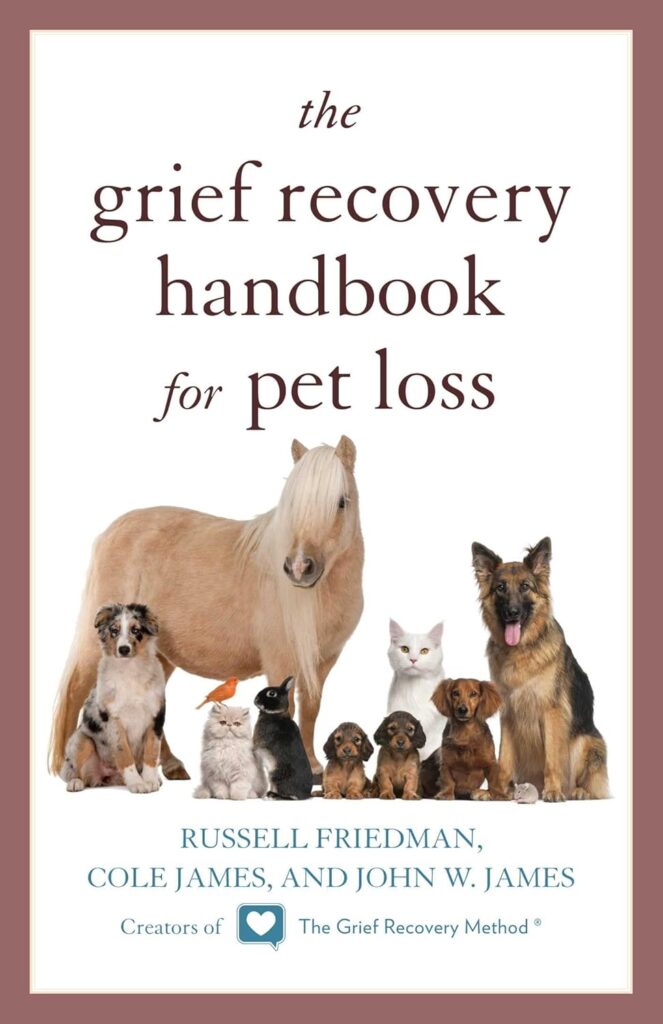
If you’re in the active, heavy part of grief and want something more structured, The Grief Recovery Handbook for Pet Loss by Friedman and James offers a method-based approach to working through pet loss that has helped a lot of people. Around $13–$17.

And if you want a place to record the dreams, the memories, the moments that feel like signs — the Pet Remembrance Journal & Grief Workbook by Conscious Minds Press gives you a structured space to do exactly that. Around $14–$20.
You Don’t Have to Make Sense of It Right Now
Dreaming of a dead pet doesn’t require an explanation to be meaningful.
The dream happened. They were there. You felt it.
That’s enough.
If grief has you searching for ways to understand what you’re feeling, the articles Is It Normal to Grieve This Hard for a Pet? and The Science Behind Why Losing a Pet Hurts This Much were written for exactly this kind of moment.
And when you’re ready to do something with all of it — the memories, the photos, the stories only you know — Everhere turns those things into something you can keep. A short cinematic film built around who your pet actually was: their personality, their habits, the things that made them them. You fill out a questionnaire, share your photos and video clips, and the film is delivered within 48 hours. It comes with a QR placard you can place in your memorial space at home. Whenever you need to feel them close, you scan it and there they are.
Not a slideshow. Not a template. Their story — told the way it deserves to be.