A small corner. A few meaningful things. A place that keeps them close.
There is a moment that comes for almost everyone who has lost a pet.
You’re moving through your day — doing something ordinary, something that has nothing to do with them — and it hits you without warning. The absence. Not as a thought but as a physical sensation, like reaching for something that isn’t there anymore.
In that moment you don’t need advice. You don’t need distraction. You need somewhere to go.
This article is about building that place.
People Have Always Done This
Before we talk about what to put in a memorial space or how to use one, it’s worth saying something simple:
This is not excessive. This is not strange. This is not a sign that you’re grieving wrong or too much or too long.
Human beings have created physical spaces to honor those they’ve lost for as long as human beings have existed. Every culture on earth, across every period of recorded history, has understood instinctively that grief needs a place to land. A location. Something you can walk toward when the wave comes rather than standing in the open with nowhere to go.
Your pet was a member of your family. They shaped your daily life in ways you’re only beginning to fully measure now that they’re gone. Creating a space in your home that holds their memory isn’t excessive.
It’s one of the most human things you can do.
What This Space Is — And What It Isn’t
A pet memorial space is not a shrine. It’s not a monument to sadness. It doesn’t need to be large, elaborate, formal, or explained to anyone who visits your home.
It’s a corner. A shelf. A windowsill. A small section of a bookcase. Somewhere that belongs to them — to the memory of who they specifically were — that you can return to whenever you need to.
It holds a few carefully chosen things. It asks almost nothing of you to create. And what it gives back — a place to direct the love that no longer has a daily destination — is something that’s very hard to find any other way.
You don’t have to build it today. But when you feel the impulse — and most people do, eventually — here’s how to do it with intention.
The Elements
Each piece of a memorial space has a job. Understanding what each one does emotionally makes the whole thing feel less like decoration and more like what it actually is — a considered, personal act of love.
A Photograph — The Anchor
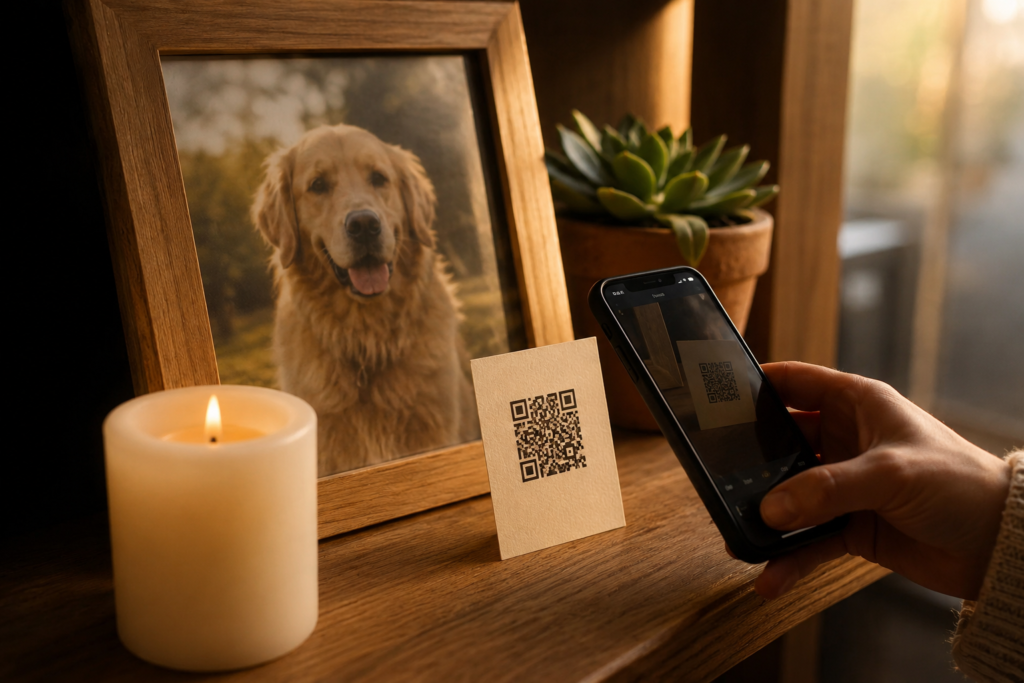
Start here. One photograph, framed, placed at the center of the space.
Not necessarily the most technically perfect photo. The right one. The one that looks the most like them — the one where their personality is visible, where something of who they actually were came through the camera. The photo that, when you look at it, you don’t just see what they looked like. You see them.
If you have a collection of photos and you’re not sure which one to choose, ask yourself this: which one would I show someone who never met them, to help them understand who they were? That’s the one.
Frame it simply. Place it where you can see it from wherever you’ll sit with this space. Let it be the first thing your eye finds when you come here.
A Candle — The Signal
A candle does something that no other element of this space does. It transforms it from a static display into an active place.
When the candle is unlit, the space is resting. When you light it, something shifts — not just in the room but in you. The act of striking a match and touching it to the wick is a small physical ceremony. It says: I am here. I am thinking of you. This moment belongs to you.
Choose a candle in a scent that reminds you of them if one exists — the outdoors if they loved walks, something warm and domestic if they were a creature of comfort and couches. Or choose no scent at all. What matters is the flame, and what lighting it means.
You don’t need to sit with it for long. You don’t need to do anything in particular while it burns. You just need to be present for a moment. Let the candle mark that this is different from the rest of your day — that you came here on purpose, to be with them for a little while.
One Object That Was Theirs — The Proof
Their last collar. A favorite toy worn soft from years of use. The bandana they wore in every photo from their middle years. A tag with their name on it.
One object. Not everything — just one thing that they touched, wore, carried, or loved.
This is the most tangible piece of the space. It’s the thing that still holds some physical trace of them — their smell, the shape of their use, the specific wear that could only have been made by them. It’s the piece of the display that makes it undeniably real.
You’ll know which object the moment you think about it. It’s probably the thing you haven’t been able to put away.
Put it here instead. Give it a place rather than a drawer. Let it be visible, honored, exactly as worn and imperfect and real as it is.
A Living Plant — The Practice
This is the piece of the space that grows.
A small potted plant — something simple, something you can tend without expertise. A succulent if you want something forgiving. A peace lily if you want something that blooms. A small herb if you want something fragrant. Whatever feels right for the space and the season and your honest assessment of how much daily attention you can give it.
Here is why this matters more than it might seem:
You spent years caring for someone. Feeding them, watching over them, attending to their needs, noticing when something was wrong. That caregiving was woven into the structure of your days so completely that you may not have fully noticed it until it stopped.
The plant gives that impulse somewhere to go. Horticultural therapy research from the American Horticultural Therapy Association confirms that tending living plants provides measurable comfort during grief — reducing anxiety and giving structure to days that have lost their rhythm.
Tending it — watering it, checking on it, moving it toward the light when it needs more — is a small act of care that belongs to this space, and by extension to them. It keeps something living in the corner of your home that is theirs. It grows slowly, quietly, in their name.
When you first set up this space, consider planting the seedling yourself rather than placing an already-established plant. Push the soil in with your hands. Water it for the first time deliberately, as the first act of this new practice. Beginning something living in their memory is its own small ceremony — one that says not just they were here but something continues.
A QR Placard — The Heart of the Space
This is the piece most people haven’t thought of yet. And it may end up being the most important one.
Photographs show what your pet looked like. Objects hold physical memory. But there is something that a still image and a worn collar cannot do — something that only becomes possible when you can see them moving, hear the sounds of your life together, watch the specific way they occupied a room.
A small placard — something simple and tasteful that fits naturally within the display — holds a QR code. You scan it with your phone. And there, in your hands, your pet comes alive again.
Not in a way that reopens the wound. In a way that honors exactly who they were. A short film built from your photos, your video clips, and the stories that only you know how to tell — crafted to capture their personality, their quirks, the irreplaceable specific truth of them. Something you can watch in two minutes or return to for the hundredth time and still find something true in.
The placard lives in the space permanently. It doesn’t require internet, doesn’t get buried in a camera roll, doesn’t disappear when a phone breaks or an account changes. It’s simply there — a door, always unlocked, that you can walk through whenever you need to feel close to them again.
The Ritual
Now that the space exists, here is how you use it.
There are no rules. There is no wrong way. But if you want a place to start — a simple practice that takes less than five minutes and quietly becomes one of the most grounding parts of your week — this is it.
You come to the space.
Maybe it’s morning, before the day starts. Maybe it’s evening, when the house gets quiet. Maybe it’s when the wave comes unexpectedly and you need somewhere to go. Whenever it is, you come here on purpose.
You light the candle.
One match. One small flame. You’re here now. This moment is for them.
You scan the code.
Watch the film. All of it, or just the parts you need today. Let yourself feel whatever comes — the laughter at something they used to do, the grief of how much you miss it, the gratitude that you had them at all. None of it needs to be managed or directed. You’re just here, with them, for a few minutes.
You tend the plant.
Check the soil. Water it if it needs it. Move it slightly if the light has shifted. A small act of care, the same kind you gave every day for years, redirected into something living that grows in their name.
You sit for a moment before you go.
Just a moment. Not long. Long enough to acknowledge that you came here, that you were present, that they are not forgotten.
Then you blow out the candle. The space rests until you return.
Coming Back
This is important enough to say directly:
You are allowed to come back here as often as you need to.
There is no point at which visiting this space means you haven’t healed enough or moved on enough or handled your grief correctly. Grief doesn’t work on a timeline and neither does love. Some weeks you may come here every day. Others you may not come for a while, and then something will remind you of them and you’ll find yourself here again, lighting the candle, and it will feel exactly right.
The space doesn’t judge. It just holds.
A year from now, five years from now, the first time you scan that QR code on a hard day and watch those two minutes and feel them close again — that’s not weakness. That’s a life in which they still belong.
Let them belong.
Building Your Space
When you’re ready — today, next week, whenever the impulse arrives — start with just two things. The photograph and the candle. Place them somewhere that feels right.
The rest will come.
And if the film at the center of the space — the one that makes the QR placard more than just a piece of card — is something you want to create, [LINK: Everhere.us] we build them with exactly this moment in mind. Not just something to watch once. Something to return to, in this space, for the rest of your life.
[LINK: Is It Normal to Grieve This Hard for a Pet?] — if you’re still finding your footing, start here first. There’s no rush.