
It’s not strange. It’s not denial. It’s one of the healthiest things you can do.
Talking to your pet after they died is something millions of people do every single day — and almost never admit to.
You walk past their empty bed and say something out loud. You catch yourself narrating your morning the way you always did when they were there to listen. You sit in the spot that used to be yours together and tell them about your day. And then you wonder, quietly, if you’re okay.
You are. And this article is going to tell you exactly why.
A Quick Note Before We Begin
If you arrived here hoping for something different — signs from the afterlife, animal communication, or ways to reach your pet in the spirit world — that’s a completely valid thing to want. We’re going to cover that in a separate article coming soon. This one is focused on the psychological and emotional value of talking to your pet after they died, grounded in what grief research and neuroscience actually show. Both conversations matter. This is the one we’re having today.
You’re Not Alone — Not Even Close
Before anything else, here is the simple truth: talking to a pet who has died is one of the most common grief behaviors there is.
Research on pet bereavement consistently shows that maintaining some form of ongoing relationship with a deceased companion — through talking, rituals, or memory keeping — is not only widespread but actively supports better grief outcomes than trying to immediately disconnect.
According to a 2025 systematic review published by the National Institutes of Health, continuing bonds with a deceased pet can serve as a valuable mechanism of support and contribute to what researchers call post-traumatic growth — meaningful, lasting development that sometimes emerges from profound loss.
In other words — staying connected to your pet’s memory, including talking to them, isn’t a sign that your grief is stuck. It may be a sign that it’s working.
What’s Actually Happening in Your Brain
There’s a reason this feels so natural — and it has nothing to do with whether you believe in an afterlife.
When you talked to your pet while they were alive, specific neural pathways were being reinforced. The sound of your own voice. The familiar subjects. The particular way you addressed them. Your brain built a well-worn groove for that specific kind of communication over weeks, months, or years of daily life together.
Those pathways don’t simply disappear when your pet dies. According to research from LoveBasxter’s grief resource center, talking to a deceased pet neurologically activates similar brain regions that were engaged during your lifetime conversations with them — which can provide genuine comfort, reduce stress hormones, and even trigger the release of oxytocin, the bonding hormone that was always part of your interactions.
Your brain is not confused. It’s not in denial. It’s reaching for something that reliably produced comfort — because comfort is what it needs right now.
What Grief Researchers Call This
The clinical name for what you’re doing is maintaining continuing bonds.
Continuing bonds are an effort to maintain emotional attachment or connection following death — representing a continuation of that attachment and an attempt to manage grief. For decades, grief research assumed that healthy grieving meant detaching from the deceased — moving on, letting go, putting the relationship in the past. That model has been significantly revised.
Modern grief researchers now recognize that maintaining a bond with someone who has died — keeping them present in your life through ritual, memory, and yes, conversation — is not avoidance. It is one of the most human and adaptive responses to loss available.
This applies to pets just as fully as it does to humans. The bond you formed over years of daily life together was real, neurologically significant, and worth honoring — not severing the moment they died.
The Specific Things Talking Does For You
There are several distinct psychological functions that talking to your pet after they died serves — none of which require your pet to literally hear you.
It processes emotion verbally. Silent rumination keeps grief inside a loop. Speaking out loud — even to someone who cannot respond — engages different neural pathways and leads to greater emotional clarity and release. This is why therapists ask you to talk rather than just think. The act of voicing something changes your relationship to it.
It honors the relationship’s significance. Talking to your pet is a small daily declaration that this relationship mattered — that it isn’t going to be minimized or quietly swept under the rug because the world didn’t make enough space for it. Pet loss is frequently dismissed by others as lesser grief. Each conversation is an act of quiet resistance against that dismissal.
It maintains beneficial neural patterns. Your brain spent years learning to find comfort in your pet’s presence. Talking to them — even in their absence — allows your brain to access some of those same calming mechanisms during the period when it most needs them.
It gives the love somewhere to go. The impulse to communicate with your pet didn’t disappear when they died. Talking to them gives that impulse a daily outlet rather than leaving it with nowhere to land.
The Question of Whether They Can Hear You
This article is focused on the psychological and emotional benefits of talking to your pet — which exist completely independently of your beliefs about what happens after death.
You don’t need to believe your pet can hear you for this to help. You don’t need to believe in an afterlife, a rainbow bridge, or any spiritual framework at all. The benefits described above — the neural activation, the emotional processing, the continuing bonds — are documented in research that has nothing to do with metaphysical beliefs.
That said, many people do believe their pet can hear them. Many find that belief comforting and grounding in ways that help them move through grief with more ease. Neither position is wrong. What matters is whether talking to your pet helps you — and for an enormous number of people, it does.
When Talking Becomes Something More
For many people, talking to a pet who has died evolves naturally into a ritual.
A specific time of day. A particular place in the house. A moment that belongs to them — where you light the candle, sit in the quiet, and say the things you’d say if they were still there listening the way they always did.
This kind of ritual does something that casual conversation can’t quite do alone — it gives grief a container. A defined space where you are present with your loss on purpose, rather than being ambushed by it throughout the day. Research on grief rituals consistently shows that intentional mourning practices reduce the intrusive, uncontrolled nature of grief over time.
If you want to build something around these conversations — a physical space in your home that belongs to your pet, where the ritual can live — this guide walks you through exactly how to do that:
How to Create a Pet Memorial Space at Home
What You Might Say
Nobody can give you the right words. But here are the kinds of things people say — in case you need a place to start:
Tell them about your day. The ordinary things — what you made for dinner, what happened at work, what the weather looked like. The mundane conversation that was the texture of your life together.
Tell them what you miss most. Get specific. The particular thing. The detail that no one else would understand. Saying it out loud makes it real rather than letting it blur.
Tell them what you’re grateful for. Not as a way of rushing past the grief — but as a way of making the whole of the relationship present, not just the loss.
Tell them the things you didn’t get to say. This one is especially important for people who experienced sudden loss — where the goodbye never happened. Speaking those words now gives them somewhere to go.
If You Want More Support
If you’d like professional guidance for moving through pet loss — written by licensed family therapists who have spent decades leading pet loss support groups — this book is the most consistently recommended resource in the field.
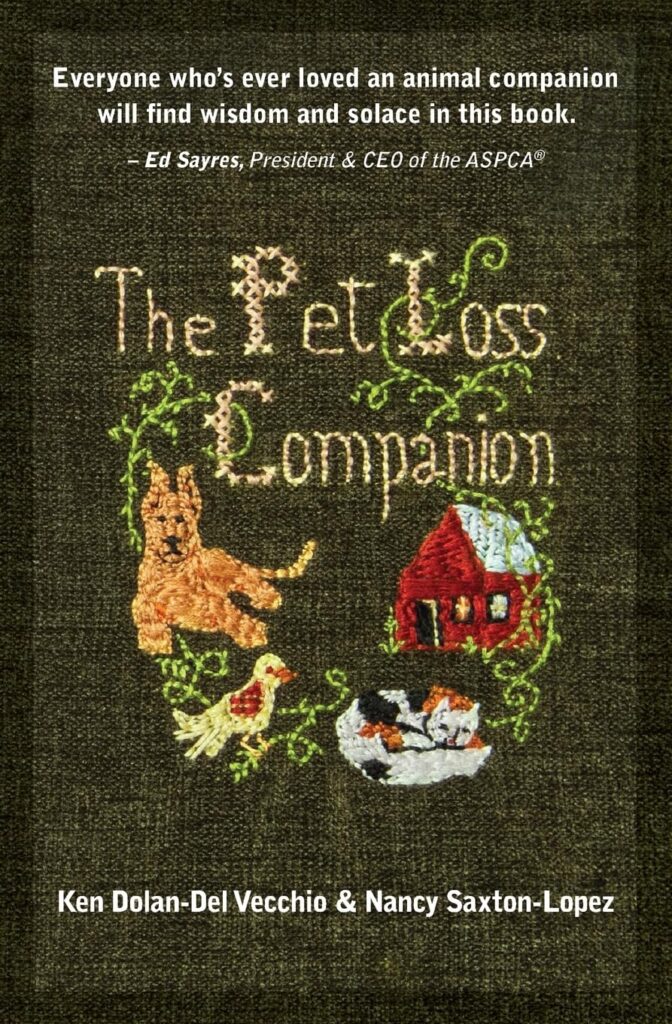
The Pet Loss Companion (on Amazon $12-$15) by Ken Dolan-Del Vecchio and Nancy Saxton-Lopez is recommended by Purdue University’s College of Veterinary Medicine, St. Hubert’s Animal Welfare Center, and dozens of veterinary professionals. It specifically addresses the continuing bond with a deceased pet — including the practice of talking to them — and treats pet loss as the legitimate, significant bereavement it actually is.
Talking to Them and Seeing Them
There is something that goes one step further than talking — that lets you not just address your pet but actually see them again. Moving, being themselves, in the specific way only they were.
At Everhere.us we create short memorial films built entirely around your pet’s personality — from your photos, your video clips, and the stories only you can tell. The finished film lives on a QR placard in your memorial space at home. You scan it whenever you need to feel close to them.
You talk to them. You light the candle. You scan the code. You watch them for two minutes.
And for those two minutes, the conversation continues.
See how it works: