
Whether you just lost your pet, or you can feel that day getting closer — this guide is for you.
When a pet dies there is no right way to lose.
Some people are caught completely off guard. Others have been quietly preparing for weeks, watching their companion slow down, knowing what’s coming but not quite ready to name it. Some are sitting with a houseful of kids who need answers. Others are sitting alone with a silence that has changed the shape of every room.
Wherever you are right now — this guide is written for you.
We’re going to walk through the whole journey together. From the early days of grief, through the ways people have found to honor their pets, all the way to creating something lasting that keeps them close for the rest of your life. Take what you need. Skip what you don’t. Come back when a new part of the journey finds you.
There’s no rush here.
First — What You’re Feeling Is Real
Let’s start with the most important thing.
If you’ve lost a pet and the grief has surprised you — if it’s bigger than you expected, harder than you thought it would be, lasting longer than the world around you seems to think it should — you’re not overreacting.
A major study published in January 2026 in the journal PLOS One found that among people who had lost both a pet and a human loved one, one in five said the pet loss was the hardest grief they had ever experienced. The brain forms the same kinds of bonds with pets that it forms with family members. The loss registers the same way. The pain is the same kind of pain.
You loved someone. They’re gone. Of course it hurts this much.
If you want to go deeper on the science of why pet grief hits so hard — and why you deserve to take it seriously — we wrote an entire article on exactly that.
👉 [LINK: The Science Behind Why Losing a Pet Hurts This Much]
If Your Pet Is Still Here — But You Can Feel What’s Coming
Not everyone reading this has already said goodbye.
Some of you are watching your pet slow down. Noticing things. Counting good days against harder ones. Living in the strange, heavy in-between of loving someone who is still here while quietly preparing for when they won’t be.
That has a name. It’s called anticipatory grief — and it’s just as real as the grief that comes after.
You’re not being dramatic. You’re not projecting. You’re responding, completely naturally, to the reality in front of you. And there are things you can do right now — while you still have time — that will matter enormously later.
The most important one is this: capture who they are before the details start to blur.
Write down the things only you know. The funny habits. The specific sounds they make. The way they love you in their own particular language. Take videos of how they move, not just how they look. These details are fragile. They’re also the most precious things you have.
We wrote a full guide on navigating this part of the journey — including what to gather, how to talk to yourself through it, and how to find support while your pet is still with you.
👉 [LINK: What Is Anticipatory Grief — And Why You’re Already Mourning Your Pet]
The Early Days After Loss — Just Getting Through
The first days after losing a pet are often the hardest.
The routine is gone. The house sounds different. You reach for them out of habit and they’re not there. People around you may not fully understand why it’s hitting this hard — and that gap between how big it feels and how little space the world makes for it can leave you feeling very alone.
A few things worth knowing for right now:
You don’t have to be okay. There’s no timeline on grief and no correct way to move through it. Some days will feel manageable. Others will knock you back to the beginning. Both are normal.
Say their name. Tell their stories. Find at least one person who will listen without redirecting the conversation. If that person isn’t in your immediate circle, pet loss support communities exist — the Association for Pet Loss and Bereavement offers free online chat rooms and support groups specifically for this.
Don’t pack everything away yet. You’ll know when you’re ready. Until then, their things can stay where they are.
If you’re in the early days and you need someone to walk through this with you — we wrote this article for exactly where you are right now.
👉 [LINK: Is It Normal to Grieve This Hard for a Pet?]
If You Have Children at Home
Losing a family pet is often a child’s first experience with death. And how you handle it — the words you choose, the space you create — shapes how they understand loss for the rest of their lives.
The instinct is to soften it. To say the pet “went to sleep” or “went away.” Child psychologists are clear that these phrases, however well-meaning, tend to create more fear and confusion than honest, gentle language does. Young children are very literal. They need the truth delivered with warmth — not the full weight of it, but the actual truth.
The other instinct is to hold yourself together in front of them. To be the composed adult who has already processed this. That instinct, too, works against you both. When your child sees you cry over your pet, they learn something important — that love matters enough to grieve, and that feelings are safe to feel.
We put together a full guide for parents of young children — covering what to say, what not to say, how to create grief rituals the whole family can share, and how a memorial video can become something your child returns to for years.
👉 [LINK: How to Help Young Children Grieve the Loss of a Pet]
Ways to Honor Their Memory
When the initial wave begins to settle — when you start looking for something to do with the love that has nowhere to go — that impulse is healthy. It’s not about moving on. It’s about moving forward while carrying them with you.
There are so many ways to do this. Some cost nothing. Some become the most treasured things you own.
Write their story down before the details soften. The specific things. The habits. The funny moments. These are the most fragile memories and the most worth keeping.
Plant something living in their name. A small pot on a windowsill. A tree in the yard. Something you tend, something that grows, something that says — quietly, in the language of living things — that they were here and they mattered.
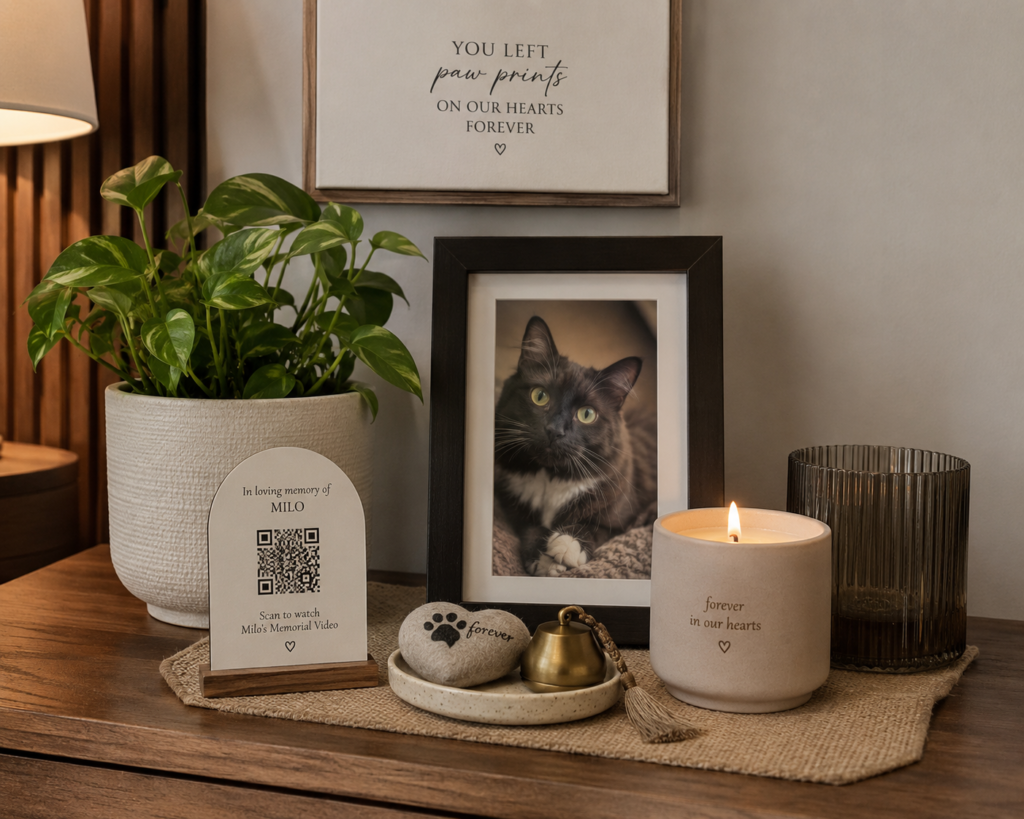
Create a memorial space at home. Not a shrine. Just a small corner that belongs to them — a photograph, a candle, something of theirs, a plant, a place for the QR placard that holds their video. Somewhere to go when the wave comes. A place with a door you can walk through whenever you need to feel close to them.
Let people help. A thoughtfully chosen gift — a personalized memorial stone, a paw print kit, a set of wind chimes for the garden — can be one of the most meaningful things someone does for you during this time. We put together a curated guide to the best of these, including affiliate recommendations we genuinely stand behind.
We go deep on all of these ideas in two articles written specifically for this part of the journey.
👉 [LINK: 10 Ways to Honor a Pet Who Has Passed] 👉 [LINK: The Best Gifts for Someone Who Has Lost a Pet]
Creating a Space That Keeps Them Close
One of the most powerful things you can do — and one of the simplest — is create a dedicated space in your home for your pet’s memory.
It doesn’t need to be large. A shelf. A windowsill corner. A small section of a bookcase. A few meaningful things placed with intention — their photo, a candle, something that was theirs, a small living plant, and at the center of it all, a QR placard that holds the most important thing.
The ritual that grows around this space is what makes it more than decoration. You come here. You light the candle. You scan the code and watch the film for two minutes. You water the plant. You sit for a moment before you go.
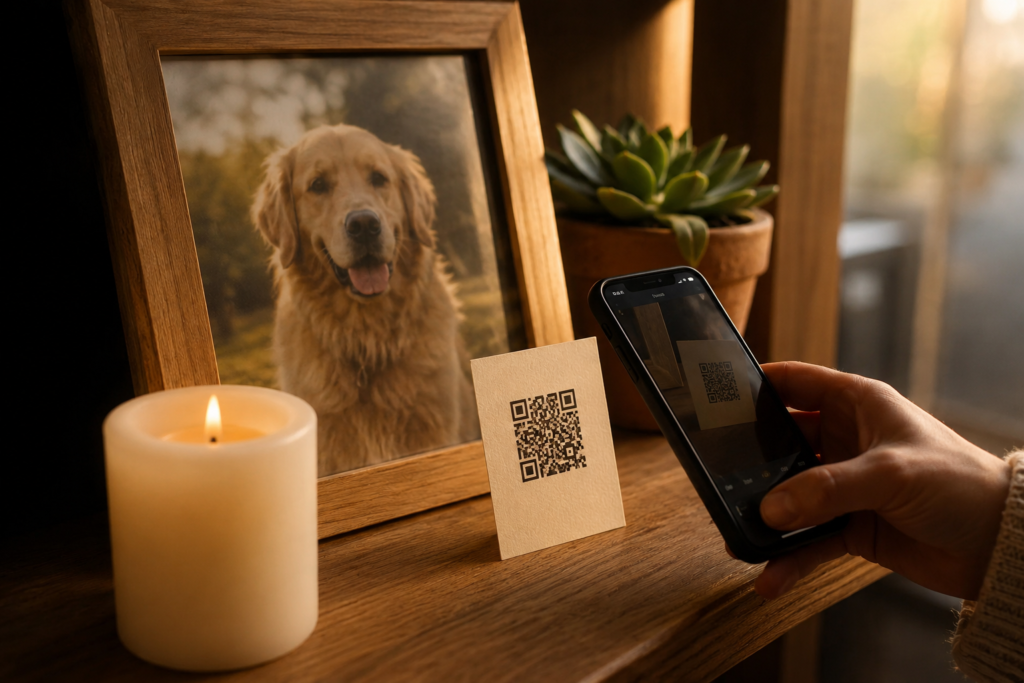
Grief that has a place to land is easier to carry than grief that floats. This space gives it somewhere to go — not just once, but every time you need it. A week from now. A year from now. Whenever something reminds you of them and you want to feel close again.
We wrote a full guide on how to build this space from scratch — including every element, what each one does emotionally, and how to begin the ritual in a way that feels natural rather than forced.
👉 [LINK: How to Create a Pet Memorial Space at Home]
Capturing Who They Actually Were
Every memorial option we’ve talked about honors the fact that your pet existed and was loved.
Most of them capture what they looked like.
Very few capture who they actually were.
Their personality. Their quirks. The specific and irreplaceable way they moved through your home and your life. The things only you know — the habits too particular to explain, the ways they loved you that no photograph could ever show.
That’s what fades fastest. And that’s what hurts most to lose.
A great pet memorial video doesn’t start with photos. It starts with questions. Real ones, designed to surface the stories that hold a personality. What did they do every single morning without fail? What was the funniest thing they ever did? How did they love you, in their own specific way?
The photos and video clips you already have — however scattered, however imperfect — become something completely different when they’re placed inside a story that makes their meaning clear. The result isn’t a slideshow. It’s a short film about someone who mattered.
We wrote an article that explains exactly what separates a meaningful memorial video from a generic one — and what to look for if you’re considering creating one.
👉 [LINK: What Makes a Great Pet Memorial Video]
When You’re Ready — We’re Here
At Everhere.us, everything we do starts with one belief: your pet deserves to be remembered specifically. Not generically. Not with a template or a stock music track and a sequence of photos in chronological order.
Specifically. The way they were. The way only you knew them.
We work with you directly — through a detailed questionnaire designed to draw out the stories, the quirks, the moments that made your pet irreplaceable. We take your photos and your video clips, however imperfect, and we build something that captures not just a life but a personality.
Something you’ll return to. Something you’ll show people when you want them to understand who you lost. Something that lives at the center of your memorial space and plays every time you scan the code.
When the time feels right — not before — we’d be honored to help you create it.
👉 [LINK: Everhere.us — See How It Works]
You Don’t Have to Figure This Out Alone
Losing a pet changes the shape of daily life in ways that are hard to explain to people who haven’t experienced it. The silence. The habits that outlast them. The love that keeps showing up even after they’re gone.
But you are not the first person to sit in this grief. Millions of people have found their way through it — not by moving on, but by finding ways to carry the love forward. Into a ritual. Into a garden. Into a film. Into a small space on a shelf where a candle burns and a plant grows and a video plays whenever they need to feel close again.
That’s what this whole site is built around. Not just memorial videos — but the whole practice of remembering well.
Bookmark this page. Share it with someone who needs it. Come back when a new part of the journey finds you.
They were worth loving this much. They’re worth remembering this carefully.